Why a cross-chain swap can take seconds or minutes
Why one cross-chain swap lands in seconds and another takes minutes: finality, layer 2 batches and the waiting a bridge has to do.
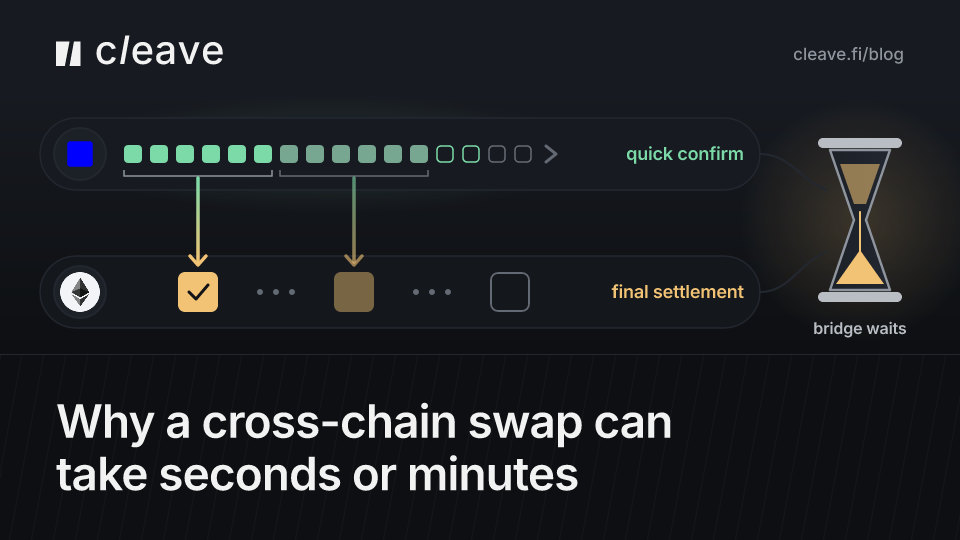
Here is a made-up case. Say you move a token from one chain to another, and the route card shows a few seconds. Later you try a different pair of chains, and the card shows several minutes. Same wallet, same tap.
Nothing is broken in either case. The gap comes from one question every bridge has to answer: when is a payment on the first chain truly done? This post walks through that question in plain words.
What done means on a chain
A blockchain adds new pages of records, called blocks. A block can be seen right away, but seen is not the same as settled for good. The word for settled for good is finality.
On Ethereum, time is divided into slots of 12 seconds and epochs of 32 slots. A transaction can be considered finalized once it is part of a chain with a supermajority link between two checkpoints, where 66% of the total staked ETH agrees on those checkpoints.
That agreement is what gives finality its weight. To undo a finalized block, an attacker would commit to losing at least one-third of the total supply of staked ETH.
It also takes a while. Under normal conditions, an Ethereum block is finalized roughly two to three epochs, about 13 to 19 minutes, after it is proposed. Finality can take longer when the network is having trouble.
A faster path, finalizing within one slot of about 12 seconds, is a roadmap goal. It is not live as of 2026.
Layer 2s have two kinds of done
A layer 2 like Optimism adds another twist. It has a quick answer and a slow answer to the same question.
The quick answer comes from a single Sequencer. Apps that trust the Sequencer can act on a transaction within about two seconds of submission on OP Mainnet.
The slow answer is hard finality: the transaction's data has been published to Ethereum, and the Ethereum block holding it has been finalized. On OP Mainnet this typically happens within about 15 to 30 minutes of submission.
Part of that gap is batching. High-throughput chains such as OP Mainnet post their batches to Ethereum every few minutes, while chains tuned for lower data costs may hold data back for up to several hours.
Why a bridge has to wait
A bridge pays you on one chain because of something that happened on another. If it pays out and the first payment is later undone, the bridge has given away tokens for nothing.
That is why research on cross-chain design states that bridging faster than the source chain's finality is not safe. Guidance for Optimism adds that bridges, and any service that takes action based on a transaction, should wait for at least the safe stage.
Most users are not willing to wait 15 minutes for finality.
How some routes feel faster
Intent-based systems have become a leading way to move value between chains. They hide much of the complexity and time constraints of traditional bridges from the person sending.
Imagine a shop with a branch in two towns. You hand cash to the branch in town A, and the branch in town B pays you out of its own drawer right away. The two branches settle with each other later, once the first payment is safely booked. You get paid quickly, and the shop carries the wait for you.
That only works when there is enough money in the drawer. Getting enough liquidity and enough active fillers across chains is one of the key difficulties for these systems. When it falls short, people see higher costs, longer waits and more failures.
So the same trip can take seconds on a busy, well-stocked lane and longer on a quiet one. The chains have not changed. Who is doing the waiting has.
What Cleave shows you
When you swap between chains in Cleave, each route card shows its expected time before you sign, marked may take longer when it can run slower. On instant routes, the time is the 90th percentile of recent fill times on that lane, or about 1 minute when the lane has no recent fills.
When several routes can carry a transfer, Cleave ranks them by how certain the outcome is, then by estimated time, then by the quoted amount. You can still pick any route, and arrival is not promised.
After you send, the transfer shows its stage, from sending on the source network through bridging to arrival, with about how many minutes are left. If it runs slower than usual, it says so. You can follow it in Activity, and the cross-chain docs explain each step.
In short
- A block can be seen quickly, but finality takes longer: about 13 to 19 minutes on Ethereum under normal conditions.
- On OP Mainnet, the Sequencer answers in about two seconds, and hard finality typically comes within 15 to 30 minutes.
- Bridging faster than the source chain's finality is not safe, so someone has to wait.
- Intent-based systems take that wait off the sender, when enough liquidity and fillers are around.
Sources
- Optimism Documentation
- Proof-of-stake PoS
- Paths toward single-slot finality - HackMD - Ethereum
- GitHub - 0xFableOrg/xchain: Cross-chain interop research, funded by Optimism Governance. GitHub
- ERC-7683: Cross Chain Intents Standard - ERCs - Fellowship of Ethereum Magicians
- Blockchain Finality Explained 2026