Gas on the destination chain, inside one quote
Why tokens can land on a new chain with no gas to move them, the common ways around it, and how one quote can cover the whole trip.
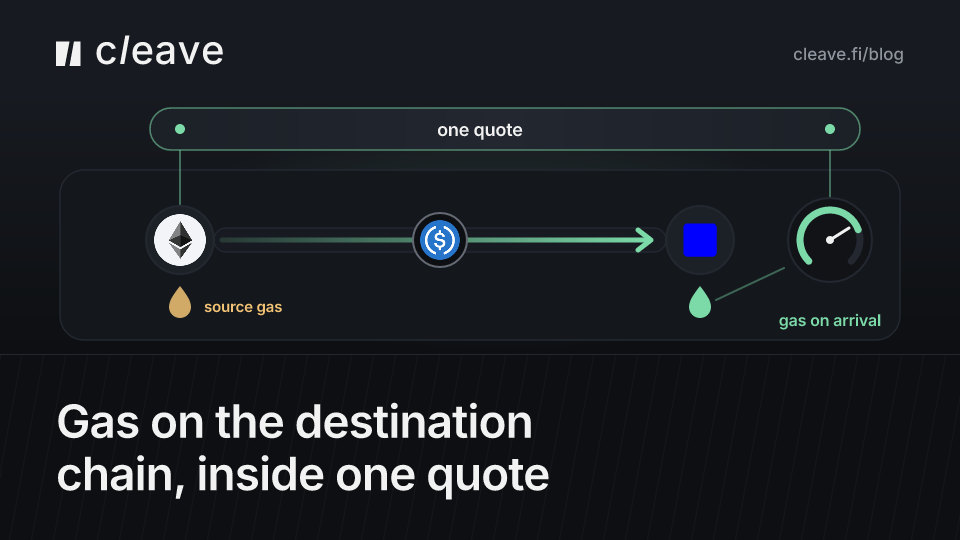
Say you move some USDC from Arbitrum to another chain. It arrives, and you can see it in your wallet. Then you try to swap it, and your wallet says you do not have enough funds. The USDC is there. What is missing is a little of that chain's native gas token to pay for the next step.
This is the destination gas problem. This post looks at why it happens, the usual ways around it, and how one quote can plan the whole trip so you are less likely to land somewhere with an empty tank.
Every chain wants its own coin
On Ethereum, all gas fees must be paid in ETH, the chain's native currency.
Arbitrum collects its fees on the chain itself, in its native currency. On Arbitrum One, that is ETH.
On Polygon, POL is the gas token. It replaced MATIC, and since September 2024 every transaction on Polygon PoS has used POL as its native gas token.
You typically cannot pay gas with the token you are moving. You have to hold and spend the native gas token of each chain involved.
Two chains, two gas bills
A cross-chain move runs separate steps on at least two chains, and each chain has its own native fee. So you pay gas on the source chain to start the transfer and, often, gas on the destination chain to claim or use what arrived.
For someone on one chain to act on another, they must first get that other chain's token.
Suppose you hold ETH on Arbitrum and send USDC to Polygon. To do anything with that USDC on Polygon, you need some POL there. If you have none, you are stuck until you find a way to get POL onto that chain first.
Timing adds one more wrinkle. Gas prices on Ethereum go up and down every twelve seconds, based on how busy the chain is. If the gas price jumps on the destination chain between the start of a transfer and its arrival, which can be minutes later, a transaction can fail when the gas limit it carries is not enough.
Ways to cover gas on the far side
Systems that handle this use a few patterns. In one, you prepay the destination chain's gas when you start the cross-chain message.
In another, independent relayers pay the native gas on the destination chain up front. They are later paid back, often with a small premium, in your source-chain asset through a smart contract.
A third keeps pools of native gas tokens on the destination chains. You pay in your origin-chain asset, and that payment refills the pools.
All of these need a way to work out what the destination gas costs in your source-chain asset. That means a live exchange rate between the two gas tokens and a good estimate of the gas units the transaction will need.
A paymaster is a helper contract that agrees to pay for a transaction instead of the sender. It can let app builders cover fees for their users, or let users pay fees with ERC-20 tokens.
Whatever the method, "gasless" transactions are not free. They shift who carries the fee.
The common thread is simple. Someone has to spend the native coin on the far side, and the cost of that gets folded into what you pay at the start. The useful part is seeing it before you sign, not after you arrive.
How Cleave plans it in one quote
When you pick a token on one network and a token on another, Cleave quotes the whole trip in one step: the swap on the way out, the bridge and the swap on arrival. You sign once on the source chain.
You can pay with a network's native coin directly, with no wrapping, and you can also receive the native coin on arrival. A route that delivers the native coin instead of its wrapped token says so before you send. When the native coin arrives, Cleave checks that the address can receive it.
For example, say you hold USDC on Arbitrum and pick POL on Polygon as the token to receive. The quote covers the swap and the bridge. If the trip finishes as quoted, what lands in your wallet on Polygon is POL, the coin Polygon uses for gas.
Each route also says how your tokens reach the destination. With Delivery included or Free delivery, the route is quoted with nothing more for you to send, though delivery may not be completed and you may still need to claim. With You'll claim on the destination, you finish there yourself, and the card shows about how long it takes and the gas you pay there.
If a later step runs on the destination, such as a claim, you pay gas on that network. If you have no native coin there, Cleave says so before your wallet opens.
Cleave's fees are included in the price.
Costs charged by others are listed before you sign: a bridge or relay fee where a route has one, a messaging fee paid in the native coin on routes that need one, and network gas.
The cross-chain docs walk through each of these steps in more detail.
When a wallet has USDC but no gas
AI agents can also top up gas through Cleave. A wallet that holds USDC but no native coin can order ETH, BNB or POL on any of the six chains by signing one USDC authorization. Signing costs no gas. Arrival is not promised.
What to check before you sign
A few seconds of looking can save you from landing on a chain with no way to move:
- The token you receive: is it the native coin of that chain, or a token that still needs gas to use?
- How it is delivered: does the route deliver for you, or will you claim on the destination yourself?
- Gas for later steps: if you will need to act on the destination, do you hold some of its native coin there?
- The costs listed: read what others charge on the route card before you sign.